Attractions
Konso Cultural Landscape is a 55 square km arid property of stone walled terraces and fortified settlements in the Konso highlands of Ethiopia.
We Ethiopians are known by celebrating several unique festivals. The best known’s are Genna (Ethiopian Christmas. Jan 7th),Timket (Ethiopian .... )
Christianity came to the Axumite Kingdom early in the 4th century when two Christian youths from Syria, Frumentius and Adesius, landed from a ship ...
748 kilometers from the capital of Ethiopia is Gondar, served daily by Ethiopian airlines, with some good hotels. The oldest of Gondar’s many imperial...
Although is largely desert and low-lying savannah, Harerge's northern reaches are mountainous and fertile, and it is there where the country's only ....
Eastwards, dust, wind, and the baking heat of the merciless midday sun create an environment where only the strong and cunning survive.Even ......
Ethiopia is situated in the north-eastern horn of Africa, equidistant between the equator and the tropic of Capricorn. its avifauna is one ......
Ethiopia is one of the best Country in the world for natural wonders. with a great geographical diversification which comprises high and rugged ......
Ethiopia has an extraordinary range of wildlife with 242 listed mammal species, 28 of these being endemic. ... Most notable of the endemic mammals......
Addis Ababa, the meaning “new flower”. It’s the capital city of Ethiopia with nearly 10 million peoples. Addis Ababa was founded by emperor Minilik in 1887. Addis Ababa has been a seating place for African union (AU) since 1963. Since Emperor Haile Selassie the AU summit and other united nations meeting has been held in Addis Ababa. The capital city of Addis Ababa is situated at the elevation of 2550m above sea level. Our city has a lot to show for tourists. Such as museums, open market, cathedral, monuments, Ethiopian fashion show, artifacts.
This museum houses one of the most important relics in the world: the 3.5 million-year-old skeleton of 'Lucy', our oldest known human ancestor. Alongside its renowned archeological exhibits, the museum also displays a fascinating collection of parchment manuscripts, antique jewelry, ceremonial robes and other priceless objects. In the garden outside the museum is a delightful buna beit, (coffee house), built in the style of a large tukul, the traditional thatched hut, where you can refresh yourself with a cup of excellent Ethiopia coffee.
The Grand Market, located in the western sector of Addis Ababa. It is the largest open market in Africa. You will be escorted around to see the artisans and vendors making and selling merchandise ranging from traditional handicrafts to modern manufactured goods, from heaps of fragrant spices to curtains of colorful clothing. Each type of product has its own area of booths and stalls where hordes of people come every day to do their shopping, all together creating a kaleidoscope of fascinating activity (peak market days are Wednesdays and Saturdays). On the edge of the vast open-air market there is also a large covered market, which specializes in the beautiful hand loomed cotton clothing, elegant silver jewelry and other such items that are on any visitor's shopping list. We will guide you to the best stalls and shops selling the items you are interested in, and we will help you bargain for the fairest prices.
Northern section of Addis Ababa and then up the encircling hills to Mount Entoto. The summit, at almost 3000 metres, is the highest point in the environs of Addis Ababa. From it you will have a magnificent view of the whole city, which lies in a great basin, the floor of an ancient volcanic crater, some 500 meters below, and of the spectacular surroundings beyond. It was here, at the end of the 19th century, that Menelik II and his court resided briefly before moving down to found Addis Ababa, the 'New Flower'. As a reminder of Mt Entoto's time as Ethiopia's capital, there are two historic churches, the Church of St Raguel and the Church of St Mary. Next to St Mary's is a charming small museum, which exhibits imperial relics as well as religious artifacts.
This majestic church was constructed in 1941. Inside you will see paintings on traditional religious themes and also an important historic mural. This cathedral is situated next to the Old Minilik Palace (the Gibbi) which this time actively a prime minister palace.
Konso Cultural Landscape is a 55 square km arid property of stone walled terraces and fortified settlements in the Konso highlands of Ethiopia. It constitutes a spectacular example of a living cultural tradition stretching back 21 generations (more than 400 years) adapted to its dry hostile environment. The landscape demonstrates the shared values, social cohesion and engineering knowledge of its communities.
The site also features anthropomorphic wooden statues - grouped to represent respected members of their communities and particularly heroic events - which are an exceptional living testimony to funerary traditions that are on the verge of disappearing. Stone steles in the towns express a complex system of marking the passing of generations of leaders.
The cultural properties including the traditional stone wall towns (Paletea), ward system (kanta), Mora (cultural space), the generation pole (Olayta), the dry stone terracing practices (Kabata), the burial marker (Waka) and other living cultural practices are reasons for the precipitation of the Konso cultural landscape to be listed on UNESCO world heritage sites list. All the necessary requirements have completed including, field studies, data collections, nomination file/document and management plan of the Konso Cultural Landscape.
Terrace: The Konso have adapted a terrace agricultural system and the core Konso area is haracterized by extensive dry stone terraces.Theses terrace retain the soil from erosion and create terrace saddles that are used for agriculture. The terraces are the main features of the Konso landscape and the hills are contoured by the dry stone terraces that could reach at some places up to 5m high. The terraces retention walls are built with heavier blocks at the base. The saddles that are prepared for agriculture are between four and eight meters wide at most places The walled town (Paleta): The Konso live in dry stone walled towns (Paleta) located on high hills selected for their strategic and defensive advantage. The Knoso villages remarkable for the beauty and simplicity of its workmanship, constructed entirely from natural materials, cultivated or constructed from the surroundings. The village is ringed by dry stonewalls, at least a meter thick and three meters high.
Mora: Cultural space of Konso located at the center of the main central enclosure and at different locations within the walls, and sometimes outside the walls. Paths from all gates lead to these Moras. The individual walled town (Paleta) has up to 17 Moras, which are connected to one other by footpaths. The Moras retain an important and central role in the life of the Konso. They usually have one or two-story grass thatched houses, called Pafta. The Mora comprise an open sided sitting area beneath a huge thatched roof with a heavy wooden ceiling and above the ceiling there is therefore an ;ittic’ the ground floor of the Mora is expertly paved to form a public area where the men gather to govern the village life. It is also a place for recreation, the youth may gather here to play chat and relax during the day when they are not working. The attic of the Mora meanwhile is where all the adult men are obliged to slip at night. They have a responsibility to protect the villages from various an expected incidences such as fire and any other attack.
Reckoned by enthusiasts to be one of Africa’s premier locations for White Water River rafting, its early fury takes it through gorges hundreds of meters deep and over fish, crocodile and hippo.
On the final leg of its journey south to Turkana, the Omo forms the border between Kefa and Gamo Gofa provinces.
It’s here that Ethiopia’s largest nature sanctuary, the Omo National park is located, with belts of forest, hot springs and extensive wilderness.
On the fringes of the national parks, the lower Omo valley is home to a remarkable mix of small, contrasting ethnic groups—not only the Bume and the Karo, but also the geleb, the Bodi, the Mursi and the Surma, the Erbore and the Hamer, to name but a few. Lifestyles are as varied as the people themselves. The Mursi and Surma, who mix basic subsistence cultivation with small-scale cattle-herding, lead lives of harsh simplicity, uncluttered by the pressures and anxieties of the modern world outside.
Mursi and Surma are renowned for the strange custom followed by their women who, on reaching maturity, have their lower lips slit and circular clay discs inserted. The larger the disc the more desirable the wearer!
The Mursi warriors still follow the custom of carving deep crescent-shaped incision in their arms to show the number of enemies they have killed in battle.
The Surma and Karo utilize various clays and vegetable dyes to trace amazing patterns on one another’s faces, chests, arms and legs. Hamer women wear their hair in dense ringlets smeared with mud and ghee. If they are lucky to find some strips of shiny metal, they add one or two to their hairstyle. Most trendy are the aluminum plate hanging from their foreheads. Jewellery tends to be simple but string- colourful necklaces, chunky metal wrists and armlets, shiny nails appended to skirts, multiple earrings and so on. Karo and Geleb sclpt their hair with mud into extravagant shapes, topped off with a redochred mud “cap” to hold an ostrich feather or two. Goatskins are plentiful and most women wear leather skirts, often embroidered with colourful beadwork or cut into long strips.
We Ethiopians are known by celebrating several unique festivals. The best known’s are Genna (Ethiopian Christmas. Jan 7th), Timket (Ethiopian epiphany Jan 19th ), Enkutatash (Ethiopian New Year. sep, 11th) Meskel (the finding of the true cross. sep 27th ). Enkutatash is celebrating throughout the country. The other three festivals are celebrated and associated with the dominant religion Orthodox Christians.
This is the most important secular holiday in Ethiopia. It is celebrated beautifully throughout the country. A person wishes and plans a new life formula them-self and to their close family and friends when they celebrate together as Ethiopians have a Tiete social life. It has a similar celebration atmosphere in the whole part of the country. Sep 11th
The legendary festival. celebrated by dominant religion orthodox. it has been an official holiday since the time of emperor Haile silassie. The Meskel celebration includes the burning of a large bonfire, local name is Demera, based on the belief that Queen Eleni, as she is known, had a revelation in a dream. She was told that she should make a bonfire and that the smoke would show her where the true cross was buried. So she ordered the people of Jerusalem to bring wood and make a huge pile. After adding frankincense to it the bonfire was lit and the smoke rose high up to the sky and returned to the ground, exactly to the spot where the Cross had been buried. Sep 27th
The Christmas in Ethiopia locally called Liddet or Genna. The same festival to celebrate birth of Christ Jesus as another part of Christian world, but different in calendar Dec 25th to Jan 7th. Genna is a family-oriented holiday. But there is no a strong tradition of giving gifts. In some areas it just happen by local festivities such as local traditional dancing as well as hockey games in the northern highland of Ethiopia.
This is a three days festival continuously from Jan 18th 20th. The orthodox priests and deacons do a colorful procession during tabot is removed from the church. Thousands of eager participant come and surrounded the church to celebrate together and take the tabot (replica ark of the covenant) with priests to the ritual site for overnight. This is by 18th of Jan
The next day by noon on Timqat Day a large crowd has assembled at the ritual site, those who went home for a little sleep having returned, and the Holy Ark is escorted back to its church in colorful procession and festivities. The clergy, bearing robes and umbrellas of many hues, perform rollicking dances and songs; the elders march solemnly with their weapons, attended by middle-ages men singing long-drawn, low-pitched voices; and the children run about with sticks and games. Dressed up in their finest, the women chatter excitedly on their one real day of freedom in the year. The young braves leap up and down in spirited dances, tirelessly repeating rhythmic songs. When the Holy Ark has been safely restored to its dwelling-place, everyone goes home for feasting. At most the festival will happen later by family gathering to eat and drink together. By this time young people’s go to the bar in the night for another festival party.
Ashandye /Ashenda, one of the great festivals which are unique for Lasta lalibela and further North like Sekota and Tigray, which takes place in August to mark the ending of fasting called filseta.(The time of the annunciation of saint virgin marry). It is an event most yearned by girls. Young girls dressed in beautiful traditional outfits and in small groups, go from house to house singing and dancing. The name of the festival “Ashenda” comes from the name of a tall grass that the girls make in to a skirt and wear it around their waist as a decoration
This festivity is celebrated on Sunday that comes following meskel. Irecha means, according to Oromo’s, Thanks giving day to their “Waqa “or God. At national level, it is celebrated in Bishoftu town in Oromyia region in Lake Hora Arsedi. On the festival Community leaders and Aba Gadas address thanks to WAQA for the blessed transition from the rainy season which is normally considered as dark to the bright and colorful season autumn (Birra). On the day different cultural dressings give a very majestic to the environment and hence worth visiting.
N.B - we are always standby to answer your questions regarding to combine this festivals in to your itinerary. - We prepare tailor made program to meet your interest at your holiday in Ethiopia.
Christianity came to the Axumite Kingdom early in the 4th century when two Christian youths from Syria, Frumentius and Adesius, landed from a ship on the Axumite coast. During Ezana's rule Frumentius was appointed the Kingdom's first Archbishop, after which the Ethiopian Orthodox Church continued to recruit Axumites to the Christian faith.
The oldest church in Africa, south of the Sahara, is the first St Mary of Zion Church, originally built around the 4th century.
Emperor Fasilidas replaced it with a newer church around 1635 which is still a place of active worship, notable for its crenellated, fortress-like walls.
Its hushed interior, resplendent with many beautiful murals and paintings, evokes a mood of contemplation in an atmosphere of antiquity.
The modern Chapel next to St Mary of Zion church is said to contain the sacred Ark of the Covenant, but no one except the Orthodox priest who serves as the chapel's custodian is allowed to enter the building.
Still accessible today are underground vaults believed to be the tombs of the 5th century King Kaleb and his son, King Gabre¬ Meske!' Steep steps made of large blocks of neatly-carved stone, which fit together precisely without any mortar to hold them in place, lead down to a labyrinth of galleries containing what appear to be coffins.
Coins minted in the reign of King Kaleb are among the thousands of Axumite gold, silver, and bronze coins unearthed since that period.
Axum is renowned for the world's tallest monoliths, or obelisks, carved from single pieces of rock. Some experts believe they were erected to mark the passing of some ancient royal personages; others say that they had an astronomical function. In ancient times seven of the tallest obelisks stood in what is today known as the 'Park of the Stelae' just north of the modern town square. The largest obelisk, measuring over 33 metres, fell long ago and now lies in pieces.
Another, 24 metres high, which was in Rome, was returned to Ethiopia in April 2005 and a third, 23 metres high, remains standing. All three of these stelae (obelisks) were neatly carved with 'doors' and 'windows' to give the appearance of very tall buildings.
Preceeding Axum, the town of Yeha was the centre of the earliest known civilisation in northern Ethiopia. But all that remains of the city-state, established in the mists of time, are the towering, yellow limestone ruins of the Temple of the Moon, which dates back to the 5th century BC.
Inscriptions and fine objects of bronze and other artefacts have been excavated from Yeha since 1909. The temple stands on a small hill, at the foot of a mountain.
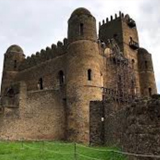
748 kilometers from the capital of Ethiopia is Gondar, served daily by Ethiopian airlines, with some good hotels. The oldest of Gondar’s many imperial structures is the impressive 17th century palace of Emperor Fasilidas. Many other fascinating historical buildings and relics can be seen in the area.
Gondar, once the Ethiopian capital, was home to a number of emperors and warlords, courtiers and kings.
Gaze down from the balconies of the many castles and palaces to imagine the intrigue and pageantry that took place back in the 17th and 18th centuries of this great city.The graceful city of Gonder, founded by Emperor fasilidas, become the capital of the Ethiopian empire around 1635.This settlement, which become fasilidas principal headquarters, grew into an important town, and remained Ethiopia’s capital, and most popular city, for over two centuries.
Fasilidas endowed his capital with a sizeable palace, known as the fasil gemb, or Fasil building. It was larger and more impressive than any structure in Ethiopia up to that time.
Fasilidas, who reputedly constructed many other buildings and bridges in the city, was succeeded by his son, Emperor Yohannes (1667-1682), and later by his grandson, Iyasu1 (1682-1706), both of whom built more palaces in the vicinity of fasil gemb. Iyasu’s most lasting achievement was the church of Debre Berhan Selassie, (the light of the Trinity), which stands, surrounded by a high wall. The inside is marvelously painted with great scenes from religious history.
Apart from the famous castle in the royal compound, visitors should inspect the so-called bathing palace of the Emperor. This two story crenelated stone structure has a flat roof and two wooden balconies.
It is set the middle of a large rectangular bath, reminiscent of a modern swimming-pool, which was traditionally filled with water brought by pipe from the nearby Qaha River. It was intended for the Timket Celebrations which commemorated the Baptism of Christ-a use to which the bath is put to this day.
Timkat celebration at GondarSeveral more palaces were raised by both Yohannes 1 and Iyasu 1. They later built a large two-story crenelated structure beside that of their grandfather Fasilidas.
The reigns of the first three Gondarie rulers thus witnessed a steady expansion of the city, in the course of which an imperial quarter came into existence.Gondar is a town of fairy-tale medieval castles and is noted for the design and decoration of its churches, masterpieces, which were constructed from stone in the form of crenellated castles, are of a significant distinctive design.
Flanked by twin mountain streams Gondar retains an atmosphere of antique charm mingled with an aura of mystery. The city was once a vigorous and vital center of religious learning and art. Painting and music, dance and poetry, together with skilled instructions in these and many other disciplines, thrived for more than two hundred years. Fasilidas and his successors saw their elegant capital as a renaissance of Ethiopian culture and so patronized the arts.
The fascination with painting, mainly expressed through church murals, icons, illuminated manuscripts and scrolls, has remained. Religious themes dominate all but the most recent Ethiopian art.
It is also worth visiting the ruins of the palace and abbey of the redoubtable 18th century Empress Mentewab at Quesquam overlooking Gondar. The royal compound, like that at Gondar proper, contains a number of buildings. The largest was apparently used for receptions and served as headquarters of the garrison.
Although is largely desert and low-lying savannah, Harerge's northern reaches are mountainous and fertile, and it is there where the country's only stretch of railway bisects the tip of the zone, leading from the nation's capital to the port of Djibouti on the Gulf of Aden.
This railway, which plays an extremely important role in the modern Ethiopian economy, carrying a large share of its imports and exports, was first conceived by the Swiss craftsman Alfred Ilg, who arrived in the country in 1877 to take up the post of technical adviser to Emperor Menelik. It was a mammoth undertaking and fraught with problems.
For every kilometer of line, more than seventy tones of rails, sleepers, and telegraph poles had to be transported ¬not to mention sand, cement, water, and provisions for the workers. The terrain was difficult: two large viaducts and many smaller earthworks had to be built within the first fifty or so kilometers of line, and others further inland. To minimize cost, a narrow gauge of only one meter was adopted, but expensive iron sleepers had to be used in view of the presence of termites, which could be expected to consume anything made of wood.
While costs continued to soar, the French, British, and Italian governments be¬gan to haggle over the 'internationalization' of the line. It all came to a head in Decem¬ber 1906, when the three foreign countries, without consulting Menelik, signed a Tri¬partite Convention 'dividing' Ethiopia among themselves. By this agreement the British and Italians recognized that any rail¬way between the Djibouti border and Addis Ababa should belong to France, while the French government agreed that the line should extend no further than Addis Ababa.
The Tripartite Convention spelled an end to hopes of internationalizing the railway. The French government ordered the railway company to repay its debts to the British and, since this was impossible, it was liquidated in January 1908. A new railway company was established two months later, under the control of a French bank.
The line was eventually extended to Akaki - twenty-three kilometers (14 miles) from Addis Ababa - by 1915, and eventually reached the capital two years later, a full twenty years after the beginning of construction work at Djibouti. The service, which has operated ever since, traverses a line of 785 kilometers (487 miles), has twenty-nine tunnels - one of them nearly
100 meters (328 feet) long ¬and thirty-four stations.
Although the original agreement speci¬fied that the line would run inland by way of Harar, the railway company soon re¬alized that they could save money by avoiding the Harar Mountains and instead pass through the nearby lowlands. It was therefore decided that the line should run to a place which Menelik chose to call New Harar - later better known by its local name, Dire Dawa.
Eastwards, dust, wind, and the baking heat of the merciless midday sun create an environment where only the strong and cunning survive.Even if the fame of the Seven Wonders of the World has been outworn and the word "wonder" itself has been misused too often, the visitor will rediscover its true meaning, when faced with the rock churches of Lalibela.
Ever since the first European to describe Lalibela, Francisco Alvarez, came to this holy city between 1521 and 1525, travelers have tried to put into words their experience, prais¬ing it as a "New Jerusalem", a "New Golgotha", the "Christian Citadel in the Mountains of Wondrous Ethiopia".
The Zagwe dynasty had come to power in the eleventh cen¬tury, one hundred years after Queen Judith, a ferocious woman warrior, had tribes up from the Semyen moun¬tains to destroy Axum, the capital of the ancient Ethiopian empire in the north.
The charming Ethiopian folklore pictures telling the story of King Solomon and the Queen of Sheba, which are sold in Ad¬dis Ababa, give a popular version of how not only the dynasty of ancient Axum (and present-day Ethiopia) descended from King Solomon,- but also the medieval Zagwe dynasty. The Queen of Sheba gave birth to Menelik, who became the first king of Ethiopia. But the handmaid of the Queen, too, gave birth to a son whose father was King Solomon, and her son was the ancestor of the Zagwe dynasty. The folklore paintings in¬clude a lovely little picture of the two women sitting side by side, their babies on their laps, the Queen of Sheba in her coral. Apparel, her handmaid in Tigray costume, busy spinning.
The Zagwe kings ruled until the thirteenth century. When a famous priest, Tekla Haymanot, Persuaded them to abdicate in favor of a descendant of the old Axumite Solomonic dynasty.
However - according to legend - before the throne of Ethiopia was restored to its rightful rulers, upon command of God and with the help of angels. Lalibela's pious zeal con¬verted the royal residence of the Zagwe in the town of Roha in¬to a prayer of stone.
The Ethiopian Church later canonized him and changed the name of Roha to Lalibela. Roha, the centre of worldly might, became Lalibela the holy city; pilgrims to Lalibela shared the same blessings as pilgrims to Jerusalem while the focus of political power drifted to the south to the region of Shoa. Legends flower in Lalibela and it is also according to legend that Lalibela grew up in Roha, where his brother was king. It is said that bees prophesied his future greatness, and Ethiopian folklore still has it that bees in a dream foretell greatness, social advance and coming riches. The king, made jealous by these prophecies about his brother, tried to poison him, but the poison merely cast Lalibela into a death-like sleep for three days. During these three days an angel carried his soul to heaven to show him the churches which he was to build Returned once more to earth he withdrew into the wilderness, then took a wife upon God's command with ,the name of Maskal Kebra (Exalted Cross) and flew with an angel to Jerusalem. Christ himself ordered the king to abdicate in favour of Lalibela. Anointed king under the throne name Gabre-Maskal (Servant of the Cross) Lalibela, living himself an even more severe monastic life than before, carried out the construction of the churches. Angels worked side by side with the stone-masons, any within twenty-four years the entire work was completed.
Coming to Lalibela you will find an atmosphere of mystery. Approaching the village in a four wheel drive from the airport you may just catch a glimpse of a group of churches.
Walking through the village you will see the quiet even austere, mountainous landscape of the region of Lasta, where the peasants labor to cultivate their patches of stony fields with the traditional hook plough. Their little huts hardly seem to offer sufficient shelter against the cold nights of this altitude. Strolling along across a gently undulating meadow, you will suddenly discover in a pit below you a mighty rock ¬carefully chiseled and shaped - the first rock church! None of these monuments of Christian faith presents itself to the visitor on top of a mountain as a glorious symbol of Christ's victory, to be sunroom far away by the masses of pilgrims on their road to the "Holy City"; they rather hide themselves in the rock, surrounded by their deep trenches, only to be discovered by the visitor when standing very close on top of the rock and looking' downwards.
These, monuments of faith - were they then intended to be monuments of a secluded life dedicated to prayer and con¬templation without regard for the riches of This World? In Lalibela itself you will find two main groups of churches, one on each side of the river Jordan, and one other church set apart from the rest. The town of Roha-Lalibela lies between the first and the second group of churches. It is situated on the higher part of a mountain-terrace on a vast plateau of rock. At Timkat (Ethiopian Epiphany, ca. January 19) a vivid ritual unfolds before the spectator: here the dances of the priests take place after the annual repetition of mass baptism in the river Jordan. There are twelve churches and chapels, including various shrines. Four churches are monolithic in the strict sense; the remainders are excavated churches in different degrees of separa¬tion from the rock. The walls of the trenches and courtyards contain cavities and chambers sometimes filled with the mum¬mies of pious monks and pilgrims. For the visitor who walks through the labyrinthine trenches and courtyards discovering at each turn new and surprising features, a few remarks about the architecture and history of the rock churches may be helpful. There are three basic types of rock churches in Ethiopia:
Built-up cave churches, which are ordinary structures inside a natural cave (Makina Medhane Alem and Yemrehanna Krestos near Lalibela are examples of this style).
Rock-hewn cave churches which are cut inwards from a more or less vertical cliff face, sometimes using and widening an existing natural cave (Abba Libanos in Lalibela).
Rock-hewn monolithic churches which imitate a built¬-up structure but are cut in one piece from the rock and separated from it all round by a trench. Most churches of this type are found in or near Lalibela (Bet Medhane Alem, Bet Maryam, Bet Giorgis, and others). Nowhere else in the world are constructions of this particular kind found.
Thus, the "construction" of a monolithic rock church was in fact an excavation. The actual method and order in which the work was carried out are thought to be fairly accurately surmised.
The workers probably cut free an oblong block of stone by sinking a rectangular trench in the tuff. From this monolith the stone masons chiseled out the church, shaping the exterior; and the interior, retaining stone for the columns, pilasters, beams and arches. The roof (e.g. Bet Giorgis, Bet Maryam) was probably decorated by the senior masons while they were waiting for the less skilled craftsmen to excavate the walls. At each level of excavate the finishing sculptural work may have followed directly on from the rougher excavation. To ac¬complish the work inside, entry was gained through the up¬permost row of windows which are usually open and only rare¬ly provided with fillings. The level of the proposed floor was reached first of all on the western side of the church in the area of the main entrance. The execution of such a great 'project poses a number of logistic problems which might also be pondered when admiring the finished work. For example, where was the excavated stone and earth carried to? How many thousands of human carriers must have· been employed? How were the stones carried away? In bags lifted upwards by ropes) was there slave labor as in ancient Egypt? How was an adequate food supply maintained and where did the masses of workers and skilled craftsmen live? And finally, what did the town of Roha look like at the period of the creation of the churches? Answers to all these questions can be hazarded but a great amount of archeological research will be necessary before really accurate theories can be formulated.
There are, however, some fairly obvious technical details to prove the high standard of technical knowledge the architects of Lalibela must have had: the churches in a group are set on several levels, in order to carry off the heavy summer rains. The trenches serve also as a drainage system to the river Jordan. With churches whose placing conforms to the slope of the ter-rain, the ridge of the roof, gutter edges, the base of the plinth, are slanted in line with it.
Whoever has experienced the "rainy season" in Ethiopia will appreciate the great skill shown by these early builders. The rains are in fact so heavy that Lalibela is inaccessible then; landing at the airport as well as an approach by Land-Rover from the main road are impossible.
You may wonder about the period of construction and about the inspiration behind this unique concept. Authorities claim that the rock churches in Ethiopia have two roots: the Axumite architecture with its palaces of wood and stone construction and with its monolithic stelae, and the early Christian basilica.
The influence of the typical Axumite wood and stone construc¬tion appears to be predominant. Originally this consisted of stone-and-clay masonry utilizing small stones and rubble, so that the walls had to be strengthened at frequent intervals with long squared timbers (the so-called "sandwich style"); these were then held in place by short round cross-pieces the ends of which became visible as rows of protruding and smoothly rounded "monkey heads". In the monolithic rock churches this type of architecture had no function but was sometimes imitated. Bet Emanuel with its horizontal projec¬tions and indentations is an excellent example. It should be remembered, however, that the famous monolithic stelae of Axum, imitating the traditional monkey-head structure of Ax¬umite buildings, were already in existence at the time of Lalibela's construction and show that the technique of creating rock-hewn monuments is of much earlier date.
The foreign influences, apparent in Lalibela, i.e., the Persian ogee-arch, may already have been absorbed into the pre¬-Christian and early Christian Axumite culture.
The most important foreign model for the Ethiopian rock churches, which was not, however, strictly adhered to, was the basilica, which originated in Greece and was an assembly hall' with a flat ceiling, a nave and two or more aisles. In order to let more daylight into the centre part the ceiling of the nave was raised to allow space for rows of windows above the lower side' aisles. Since the fourth century it was regarded in the Christian world as the correct shape for a church building. The models of the first Ethiopian churches very likely all date from before the time when bell towers were introduced in the east and west Mediterranean.
An important aspect of the basilica concept was that the church should be orientated with the holy of holies towards the east, the narthex (main entrance hall inside the building) being in the west. It is characteristic of Ethiopian churches that there should be three external doors -not less, not more-¬and that there are usually three openings to the holy of holies. You may be permitted to enter the church; permission to enter the holy of holies; however, is traditionally only granted to the priests serving mass. The most important piece of fur¬niture in the Ethiopian church is the tabot on the altar. The tabotis a slab of stone or wood, currently understood to be an imitation of the Tables of the Law. According to legend, the son of King Solomon and the Queen of Sheba, Menelik I, brought the Ark of the Covenant with the Tables of the Law from Jerusalem to Ethiopia, and they are now believed to be kept in Our Lady of Zion Cathedral in Axum.
The tabot are decorated with paintings or engravings depicting the particular saint to whom they are dedicated. The bishop consecrated the tabot, not the church, the tabot then confer¬ring sanctity on the church. In a broader sense, the "tabot” an signify the sanctuary with the altar, as well as the whole church, which is dedicated to the tabot's patron saint.
While you may in rare cases be allowed to see the holy of holies, the tabot is never shown to the public. During proces¬sions the priests carry the tabot on their heads, and it is covered on such occasions with an embroidered or brocaded cloth.
Authorities contend that the rock churches were not con¬structed all at one time, and it has even been conjectured that the oldest are the more refined ones strictly adhering to Axumite style. While the first rock churches may originate from the late Axumite period and the newer ones in Ethiopia cer-tainly were constructed after Ahmed Gragn's devastating wars in the sixteenth century, the most important ones, in par¬ticular in Lasta, which includes Lalibela, were all created dur¬ing the Zagwe period.
It is also assumed, though not proven that at least the senior craftsmen came from other regions, e.g. Egypt or Jerusalem. A nineteenth century traveller is said to have seen a manuscript according to which King Lalibela hired foreign craftsmen, and a similar document is said to be in the possession of Bet Maryam But here, too thorough research is required to clarify the problem.
The paintings in the churches are all from a later date some originating in the fifteenth century, some in the seventeenth and eighteenth centuries. Byzantine motifs are found in fifteenth century paintings proving long standing contact with the Byzantine world.
The rock churches thus reflect the blending of Axumite tradition and early eastern Mediterranean Christianity: Yet they are an entirely new creation of early Christian art on Ethiopian soil.
Ethiopia is situated in the north-eastern horn of Africa, equidistant between the equator and the tropic of Capricorn. its avifauna is one of the richest in Africa. Ethiopia is becoming one of Africa’s most wanted country for birding adventure.
Birders worldwide are becoming aware of the unique bird list of Ethiopia.
The bird species of Ethiopia are mix of African, Palearctic and a fantastic number of endemic species makes Ethiopia a poplar and recognized country for birding adventure around the world. More than 920 species of birds, some 590 are resident species wile 220 species are seasonal migrants, 76 of which are Palearctic migrants. 31 species are of global conservation concern needing special protection measures. The other 26+ Species are endemic to Ethiopia.
It is also very possible that further species await discovery in the forests and parks of the country.( the wing of an apparently endemic species of nightjar was discovered as recently as 1992 in Nech-sar National Park, and the live bird was first seen in 2009) “bradt guide” truly a birding country.
As much as possible the selected places for birding will be inserted in to the tour date or itinerary. Whatever most of this birds are will be visible at most probable confidence at selected bird sanctuaries.
Ethiopia is one of the best Country in the world for natural wonders. with a great geographical diversification which comprises high and rugged mountains, flat-topped plateaus, deep gorges, valleys and vast rolling plains dissected by rushing streams that are tributaries of famous rivers like the Abay (the Blue Nile). Its altitude ranges from the highest peak at Ras Dashen 4620m above sea level, down to the Dallol Depression, about 116m below sea level. The tropical climates, its physical conditions and variations in altitude have resulted in great diversity of terrain, climate, soil, flora and fauna.
SO, Ethiopia is one of the richest country in the world by its natural wonders in the four quadrants of the country. Accordingly, these natural attractions are listed down from the desert to the highlands as well as numerous wild life reserves (national parks) and numerous lakes too.
lies at 136,956 km square (52,879 sq miles) of arid terrain close by Eritrea and Djibouti boarder which it has a complex geological history. The Danakil Depression is the hottest place on Earth in terms of the average temperature throughout the year.
is centered over the East African Rift system and situated at an elevation of 613m (2,011 ft) high, the longest-existing lava lake since maybe over hundreds of years. It occasionally overflows on the side of the volcano mountain. Volcanoes with lava lakes are very rare to find in the planet. So; Ethiopia is proudly promoting its natural beauty through us
Ethiopian mountains are known for their biodiversity. They also boast of spectacular beauty and Comprises a high plateau with tall, precipitous cliffs and chasmic river valleys. Semien Mountain, Balle Mountain and Abune-Josef Mountain are among the others, but these are famous and well-known by their chained and dramatic views of the rugged mountains.
The home of mount Ras-Dashen, which is the highest peak country that raised up to the elevation of 4,620m above sea level. As well as Mount Ancua, and Mount Bwahit, is a part of other peaked mountains among the rugged mass of mountains found in the park. Park is seated at a wide coverage of 412km square
Which hosts Mount Tullu Dimtu, is waiting to be declared a world heritage site? (2,150 square kilometers) The park's Afromontane habitats have one of the highest incidences of animal Endemicity of any terrestrial habitat in the world including the Ethiopian wolf.
Situated at an altitude of 4,280m within a natural grace of its breathtaking views of the chained mountains structure, Water rivers and gorges. Ethiopian third-highest mountain abune-yosef is covered some 72 k.m square. Its biodiversity is very tangible by its avifauna including the endemic wildlife such as, Ethiopian wolfs, gelada baboons, a few furtive leopards, and isolated hamadryas baboons. As well as a typical highland birds such as lammergeier and others.
;, is a 4,575-square-kilometre (1,766 sq mi) national park in Ethiopia, near the South Sudanese border. It is the nation's largest national park. Gambella is located 800 kilometers from Addis Ababa, Gambella National Park has one of the highest concentrations of wildlife in Ethiopia, 69 mammal species occur in the protected area including African elephant, African buffalo, White-eared kob bushpig, common warthog, giraffe, hippopotamus,kéwel, Nile lechwe, sable, tiang, topi, and waterbuck, cheetah, leopard, lion, mantled guereza, olive baboon, patas monkey, andspotted hyena. And including more than 320 bird species.
found in the southern Ethiopia. This park is a good eco-logical conservatory for different fauna and floras. It Is found between two lakes Abay and Chamo lake.
this park is 225 kilometers east of Addis Ababa, with its southern boundary along the Awash River, and covers 756 square kilometers of acacia woodland and grassland. The park in Awash River gorge has amazing waterfalls. In the upper Kudu Valley at Filwoha is hot springs amid groves of palm trees.
is the National Parks located in the Southern Ethiopia about 782 kilometers from Addis Ababa.bend in the Omo River, the 2162 square kilometers of this park are divided by the Mago River, which a tributary of the Omo river.
the Lake was nominated as a UNESCO Biosphere Reserve recognizing its national and international natural and cultural importance. This is first largest lake in Ethiopia by a size approximately 2,500km square. This is the source of river Nile which is Long Distance Running River finish its journey at victoria. 37 islands on the lake, monasteries and churches are built on the 18 islands.
is found in Arba Minch in southern Ethiopia. The lake is surrounded by a popular park called Nech sar. Several wildlife come to the shore for their daily water need. The lake is a home for different fishes and water animals including catfish Bagrus docmak and Nile perch, as well as hippopotamus and Nile crocodiles.
200 kilometers (124 miles) away south of Addis Ababa. Naturally itself situated at an amazing spectacular volcanic gorge and surrounded by foggy hills. This is very important lakes for aquatic bird life, particularly those that feed and breed on lakes in large numbers. Seasonal migratory birds are often available to be seen here.
The brown lake which is best known place for the weekend outside Addis Ababa, comfortable and recreational place for tourist including the domestic weekenders. Birders often come to this place for overnight. The same 200km south of Addis Ababa.
40 km FROM ADDIS Bishoftu is rich in 7 (seven) creator lakes & there is one different man-made lake which have beautiful scenery. Almost all the lakes give attractive scenic beautiful surrounding rocky steep invites for sightseeing and nature admiring. Domestic and international tourist chooses this place for weekends.
Formed by the Web River as it changed its course in the distant past and carved a new channel through limestone foothills, the Sof-Omar system is an extraordinary natural phenomenon of breathtaking beauty.
120 kilometers (74 miles) far from Balle , through a low valley filled with thorn trees and weird funnels of termite hills, and you'll come across one of the most spectacular and extensive underground caverns in the world: the Sof Omar cave system.
Here, the Web River vanishes into this giant underground world with its arched portals, high eroded ceilings, and deep, vaulted echoing chambers. These caves, now an important Islamic shrine named after the saintly Sheikh Sof Omar, who took refuge here many centuries ago, have a religious history that predates the arrival of the Muslims in Bale - a history calibrated in thousands, not hundreds, of years.
The first religions of this part of Africa revolved around spirit worship and ghost cults in which the most powerful super¬natural beings were believed to attach themselves to trees, rocks, and, most forcefully, to caves, which became places of veneration where prayers were offered up and sacrifices made. Even today, the visitor to Sof Omar will see many signs of the persistence of such pagan beliefs and practices.
Ethiopia has an extraordinary range of wildlife with 242 listed mammal species, 28 of these being endemic. ... Most notable of the endemic mammals are the gelada baboon, the Walia ibex, the Menelik's bushbuck, the mountain nyala, Swayne's hartebeest and the Simien fox.
Most species of wildlife are present, but the numbers in Ethiopia are down in all of its parks. Only few species occur in relatively large numbers, such as buffaloes in Gambella National park, and Zebras in Nechisar National Park. However, what is lacks in numbers, is compensated with extremely rare and endemic mammals and endemic birds.
Some of these species only survive worldwide with less than 100 individuals like the Somali Wild Ass, or a few hundred animals like the Ethiopian Wolf, the Walia Ibex and the Swayne's Hartebeest. So, in Ethiopia, one goes on safari hoping to see some of the extremely rare and endemic animals of Ethiopia, rather than hoping to see large herds with many different species. Some are actually quite easy to see in the wild, like the mountain endemics, while others are so rare that even experts have difficulty finding them, like the Somali Wild Ass.
We will organize special expeditions based on your request and interest to any part of the park and wilderness where will be convenient for wildlife safari.